
4 Resources You Should Read to Get Better at Agentic Coding
My learnings are your learnings

By now, I’ve probably spent over 1,000 hours using Claude Code.
And yet, I’m still curious. Every day, I explore new ways to sharpen my skills.
One of the best pieces of advice I’ve received from our VP of Engineering is simple: stay curious.
Over the past few days, here are a few things I’ve been learning about:
MCP for Chrome DevTools
Skills in Claude Code
Building effective AI agents
Codex: Why to keep an eye on it.
Let’s dive in.
1.) F*ck yeah: MCP for Chrome DevTools
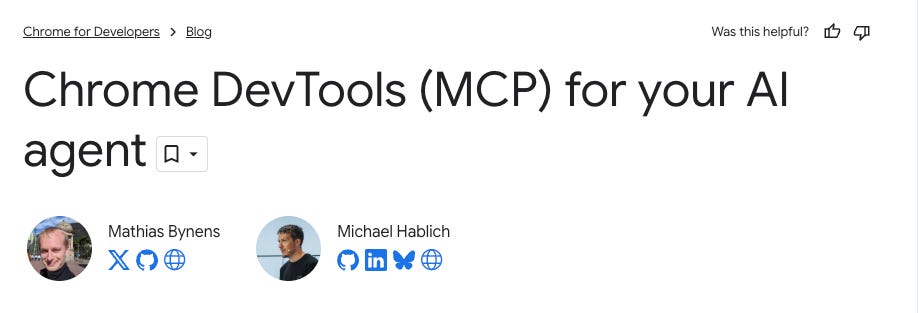
Google has launched a public preview of Chrome DevTools as an MCP server. For the first time, AI agents can debug real web pages instead of guessing what’s happening behind the scenes.
Here are three key takeaways:
Real browser access. Agents can inspect the DOM, CSS, network calls, and console logs just like a human developer.
Full debugging capabilities. They can record performance traces, analyze errors, and verify that code changes actually work in the browser.
No more blindfolded coding. This integration removes the gap between “code generation” and “code execution,” letting agents see and fix what they build.
I’m super excited about this one because I use Chrome DevTools every single day.
Lear more here.
2.) Skills: Declutter your Claude.md
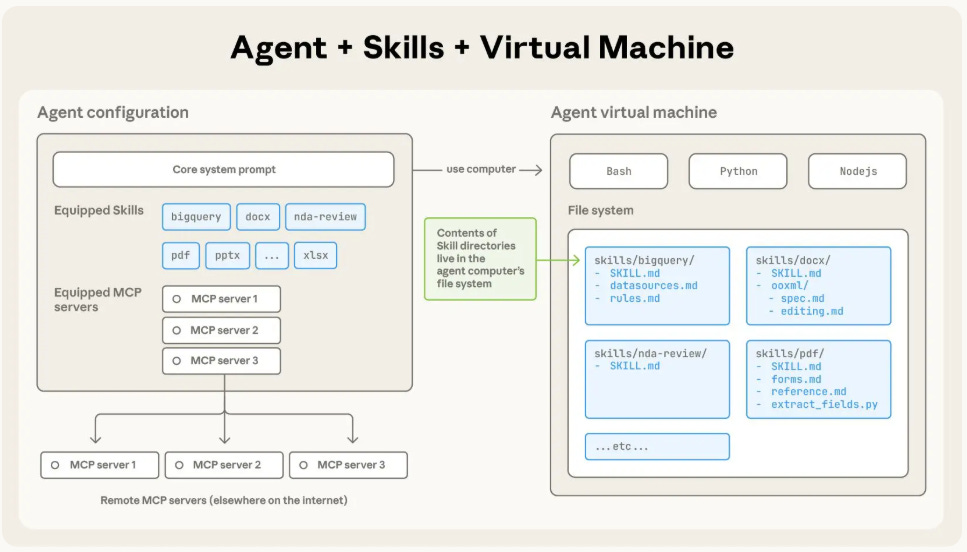
A Skill is a directory that contains a SKILL.md file along with organized folders of instructions, scripts, and resources that give agents additional capabilities. Anthropic recently released Agent Skills, and I learned more about them by reading their engineering blog post.
Here are a few key learnings:
Most AI agents act like bright interns. They’re fast learners but easily lost without structure. Anthropic’s new Agent Skills system changes that by teaching agents to load expertise only when they need it.
Package knowledge into folders. Each Skill is a directory with a
SKILL.mdfile, docs, and scripts that teach the agent how to work in your domain.Use progressive disclosure. Claude reads light metadata first and dives deeper only when the task demands it, keeping context short and sharp.
Think reusable, not disposable. One well-designed Skill can power your chat app, internal tools, and automation all at once.
Agent Skills turn a capable generalist into a focused specialist.
Here are three best practices:
Start with evaluation. Identify where your agent struggles on realistic tasks, then build Skills incrementally to address those gaps.
Structure for scale. When a
SKILL.mdbecomes too large or unwieldy, split it into referenced files. Isolate rarely used paths and use executable tools where appropriate.Think from the agent’s perspective. Monitor how the agent triggers and uses the Skill, refine its name and description metadata, and iterate based on usage rather than theory.
A must-read article by the Anthropic engineering team if you want to learn more.
You can find a bunch of interesting Skills and plugins for Claude Code here: https://github.com/wshobson/agents
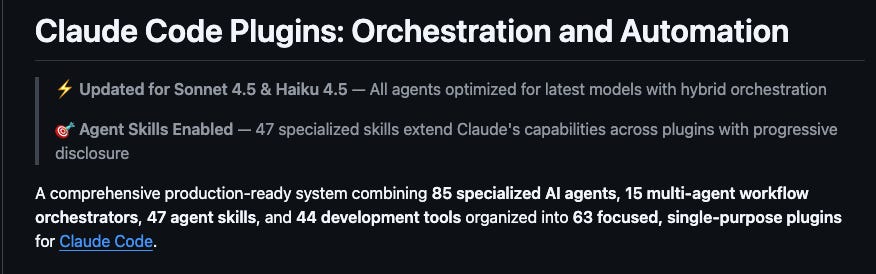
Side note: you can also use Claude to help you create Skills:
3.) How to Build More Effective AI Agents
I recently watched a great conversation with Erik Schluntz, who focuses on multi-agent research at Anthropic. There were some interesting learnings about how Claude is being trained to act like an agent, not just chat.
Coding is its core skill, and that strength now spills over into planning, search, file creation, and tool use.
Here are three key takeaways:
Coding first unlocks everything. Claude writes code to create artifacts and speed up repetitive work, which beats manual clicks.
From workflows to agent loops. Closed-loop agents now beat linear workflows for quality, and “workflows of agents” chain focused loops step by step.
Multi-agent patterns matter. Orchestrators spawn sub-agents as tools, parallelize tasks, and use MapReduce-style splits while protecting the main context.
Three tips from Erik Schluntz on building effective agents:
Think like the agent. Check logs and make sure each step gives Claude everything it needs — no hidden assumptions.
Design tools like a UI, not an API. Give one tool that returns the full context the model needs, not multiple endpoints it must stitch together.
Instrument and iterate. Keep the core loop minimal, then refine with evaluations before adding new agents or tools.
Learn more by watching the video:
4.) Why You Should Keep an Eye on Codex
OpenAI launched a new IDE extension that brings Codex directly into VS Code, Cursor, and other editors. It turns your IDE into a shared workspace where Codex can explore, edit, and even run tasks safely, both locally and in the cloud.
Context-aware collaboration. Codex automatically understands your current file and recent edits, letting you ask natural questions like “Why is this clause here?” without referencing files.
Local and cloud workflows. You can start a task locally and hand it off to Codex Cloud for parallel attempts or continued progress, perfect for long-running or creative work.
Multi-attempt problem solving. Codex can try several design or implementation ideas at once and show the results side-by-side, helping you pick or merge the best version.
My take:
While I mostly use Claude Code, I keep an eye on what OpenAI is building with Codex. A few things make it stand out:
It’s fully open source, which usually means there will be a strong community around it — maybe even bigger than the one around Claude Code.
Its vision of agentic coding is slightly different. Claude Code feels like a fast, collaborative teammate you guide closely, whereas Codex aims for full autonomy, coding and executing tasks in the cloud without you watching every step.
As these models grow more capable, and as I get better at steering them and setting the right context, Codex’s autonomous approach is something worth keeping in mind.
Take a look at the video:
Offtopic: Options Trading
I’ve been learning more about options trading (mostly by talking to GPT on the toilet 😄). I’ve always been a bit afraid of it because the advice everywhere is the same: “Just do ETFs and chill. Don’t do options. You’ll lose it all.”
But the more I read, the more I’m convinced that options can actually be a useful tool to become a more diversified investor.
While ETF and chill is still my main strategy, I plan to allocate a small part of my portfolio to options. If you are curious about my journey and whether I will lose it all, let me know. I might start mixing in some content about that too. Maybe one day I will even find a way to combine agentic coding with options trading. Let’s see. 🙂
Cheers,
Lorenz